[034]
Seduced & Abandoned: The Body in the Virtual World - The Feminine Cyberspace
Individual
critical
Sadie Plant argues that cyberspace is a potentially radical space which uses modes of thinking and operating that have traditionally been seen as female. She also considers the relationship between cyberspace and immaterial space and speculates on what this could mean for the future. Christine Tamblyn and Pat Cadigan contribute to the discussion/Q&A, which makes for a lively discourse on the females positioning in technoculture.
17.11.26
[068]
ŠUM#22 Angel Mode
Collaboration
philosophy

ŠUM22: ANGEL MODE 🪽 Design by Jaka Neon🪽Edited by Maks Valenčič and Tisa Troha
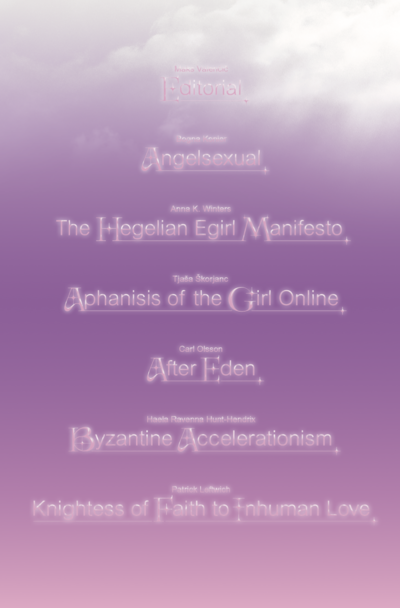
ŠUM22: ANGEL MODE 🪽 Design by Jaka Neon🪽Edited by Maks Valenčič and Tisa Troha
The journal ŠUM#22 – Angel Mode explores themes in contemporary art, theory, and speculative fiction. Key articles include topics such as online identities, accelerationist philosophy, the concept of "angelic sexuality," and reinterpretations of faith and love in the digital age. Contributors like Bogna Konior and Haela Ravenna Hunt-Hendrix discuss theoretical frameworks connecting cyberculture and philosophy. The issue is edited by Maks Valenčič and Tisa Troha.
The Angel Mode Issue explores the intersection of online aesthetics and identities, focusing on the "angel" as a symbol for transcendent, hyper-feminine personas. This ties into ongoing online discourse of femininity, vulnerability, and performance, often communicated through ethereal-esque aesthetics, cyberpunk references, and soft romanticism style write-ups. The "angel" metaphor also critiques our roles in cybernetic systems, where humans act as conduits for larger external forces. Embracing this mode reflects a shift from individuality toward alignment with overarching digital and 'transcendental' patterns.
“As human agency erodes, faced with singularity and extinction, the figure of “the girl (on the internet)” is on the rise. In the new issue of Šum we explore how this surrender of agency mediates (human) history itself.”
17.11.26
[095]
of techne and logos
Individual
critical
'Of Techne and Logos' is a thesis project by Anna Trevisan that explores the cyborg as a condition of digital life and a lens through which to examine gendered power. Across a series of essays, Trevisian considers how digital identity emerges in relation to bodies, images and platforms. The Cyborg Condition, examines the promises of control, belonging and escape offered by online self-presentation, as well as the ongoing work of curation, consumption and self-surveillance that these promises require. 'Programmed to Perfection' expands upon this investigation by examining Ex Machina and Her, tracing the persistence of female cyborg ideals across visible bodies and disembodied voices, reinforced by costumes, interfaces, and atmospheres. A tactile prologue and epilogue contextualise the research as situated practice, and the independently published website extends the inquiry into digital form. The study also acknowledges its limitations, particularly its underdeveloped attention to race, class and genderqueerness.
A productive tension emerges between the essay’s description of unequal systems of aesthetic control and its sweeping assertion that 'we are all cyborgs'. This highlights the profound impact of technology on contemporary life, prompting the question of whether everyone experiences this condition with the same agency or exposure to harm. This question is also relevant to Oftechne.ink, which combines two elements: an exploration of the cyborg as a metaphor and an experimental publishing space driven by code. Built and maintained independently, the site incorporates its mode of circulation into its argument: it is digital, open-source and self-directed.
17.11.26