[088]
The Archive Of Patchy Studies
Individual
critical
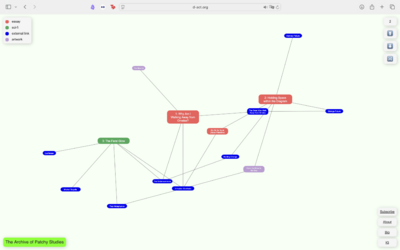
Archive Of Patchy Studies (screenshot) by Noam Youngrak Son
Archive of Patchy Studies is a living, diagrammatic platform by Noam Youngrak Son that maps knowledge through a rhizomatic, non-extractive interface. Designed as a motherboard of interconnected nodes-ranging from essays and images to links and notes-it visualizes conceptual, aesthetic, and affective relations without relying on rigid taxonomy. The archive grows organically, shaped by conversation, intuition, and resistance to capitalist tempo.
Rather than simply storing information, it proposes an alternative infrastructure: one where artistic labor circulates relationally and ethically, inviting slower, situated forms of engagement and meaning-making over time. Some content remains open; other nodes are accessible via subscription.
Diagrams, especially interactive, rhizomatic ones like Son's 'rhizomatic motherboard', challenge traditional data visualisation norms by turning static charts into dynamic, interconnected maps. Unlike dashboards or classification-driven graphs, these diagrams emphasise emergence, fuzziness and mutual causality. Treating the connecting nodes as active elements rather than fixed data points emphasises the importance of non-hierarchical, networked representations, and illustrates how diagrams can become lively and inclusive infrastructures.
“Over time, I hope this platform becomes not just an accumulation of information, but a transformative infrastructure: a space where artistic labor is not extracted, but comes to obtain other forms of value mutually.”
17.11.26
[090]
Vanish Pointer
Individual
experimental
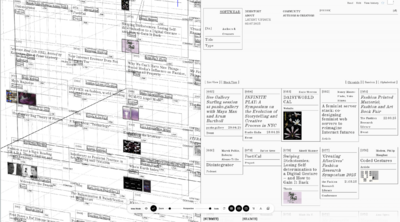
Vanish Pointer by Hyunseo Cho (as used on the Softwear Directory)
Vanish Pointer is a web-based project by Hyunseo Cho that reimagines the digital interface as a three-dimensional, perspective-based space. Designed as both a web extension and a standalone platform, this tool establishes an analogy between our perception of web interfaces and the visual system of perspective. Users can shift the vanishing point to explore websites from new angles, transforming flat webpages into dynamic spatial environments where citational elements — such as sources, authors, dates and internal references — become central structuring forces. Users can invert hierarchies, reveal hidden relationships, and explore multidimensional connections by changing their viewpoint — including curvilinear, panoramic, and spherical perspectives. Vanish Pointer thus encourages critical and sensory engagement with the knowledge architectures that shape online content.
In an age where information circulates endlessly, is remixed and is decontextualised, developing visual citation methods is not just a matter of giving credit; it is an urgent way of taking relational accountability. The hypertextual nature of our digital environments is full of hidden lineages: sources, references and contextual cues that are often obscured by flat, linear design conventions. Experimental approaches such as Vanish Pointer reclaim these overlooked dimensions, rendering citation as a spatial, visual and navigable architecture, not just metadata. By reimagining interfaces as relational terrains, such tools encourage users to think critically about how knowledge is structured, traced and performed, transforming acts of reading, browsing and linking into moments of situated awareness.
In doing so, they foreground citational relationality — an understanding of citation as an active, situated practice that reveals the networks of dependency, influence and care underpinning digital knowledge, rather than as a static reference.
17.11.26
[096]
Maisa in Webland
Individual
philosophy
In Maisa in Webland, readers embark on a journey of discovery examining the pitfalls of contemporary web design, user experience (UX) scripts and how online behaviours such as stalking, teasing and ghosting have become survival and belonging mechanisms under capitalism. Through a combination of interviews, case studies, fiction, and critical theory, Imamović explores ways to resist the pressures of platform optimisation, automation, and the pursuit of toxic rewards, such as emoji-filled validation.
Rather than promise an escape from platform logic, Imamović asks how we might stay critical while attached. Her outlined Webland is a compromised terrain, but also one we can keep reimagining together.
In contemporary online fashion, platform logic shapes where we shop, but also conditions what becomes recognisable as fashion. Feeds and recommendation systems reward images that hold attention, while creators are pushed towards constant posting, trend awareness, and a consistent personal style. This smooth experience rests on Imamovic's outlined platform logic, through data collection, commercial metrics, and (often precarious) creative labour.
Imamović’s attachment to criticality points out that, while we may rely on platforms to discover and share fashion we can simultaneously question how they organise attention. To rethink our collective Webland could mean making room for other ways of encountering fashion; slower, more reciprocal spaces in which connection and exchange matter alongside visibility and sales.
17.11.26