[027]
Fashion Paratext Dataset
Collaboration
critical
The FASHION PARATEXT DATASET focuses on the collection and analysis of fashion captions within contemporary fashion media. Although often overseen and rendered subordinate, these paratextual snippets of text-such as titles, introductions and captions-work as strategic value producers within fashion media and shape our fashion narratives and vocabulary. Accordingly, these textual elements play an important role in our relation to fashion and clothes as readers, wearers, makers and consumers. Through its dominance and vast networks, industrial market-based fashion language is becoming our fashion mother tongue. And as professor of applied linguistics Robert B. Kaplan writes, our first language, or mother tongue has a powerful influence on the way we shape our thoughts and organise our ideas.
Using data science methods, this project collaboratively produces a large-scale dataset of fashion captions that can be mapped and analysed using Natural Language Processing. The dataset takes the captions out of the saturated pages of fashion media (both print and online), offering the opportunity to read them attentively, isolated from their original context. As such, it can open up space to think about an alternative vocabulary.
“This website explores the unique poetic character of fashion captions, and text in general of its media systems.”
29.10.26
[060]
Fashion is not a Sign: Reading P.R.A.D.A. Theory-Fashion and Luxury Language
Individual
critical
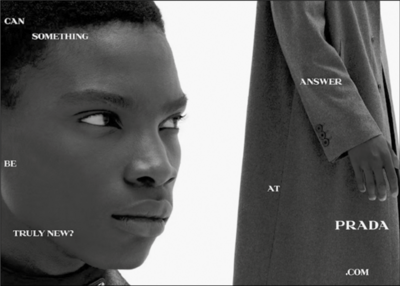
Prada Spring/Summer 2021 campaign by Ferdinando Verderi. Courtesy of the photographer and Prada

Prada Spring/Summer 2021 campaign by Ferdinando Verderi. Courtesy of the photographer and Prada
“It is obvious enough why a clothing company might align itself with art or theory: to spritz its all-too-worldly wares with the air of intellect.”
29.10.26
[092]
A Slip Of The Tongue
Individual
critical
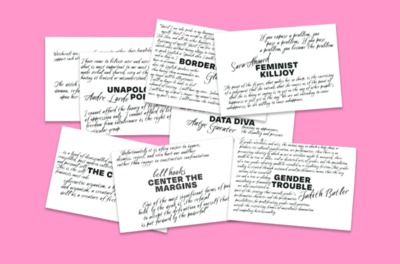
A Slip of The Tongue bye Feline Artz
After the personal realisation that she unconsciously and unwillingly reproduced sexist patterns in the way she spoke and thought, Feline Artz initiated a project began as a series of consciousness-raising meetings about sexist language. Over time, the meetings themselves became part of the inquiry, and the project developed into an ongoing collection of speech tools and experimental methods. The cards support conversations around language and hierarchies, with the aim of revealing the often invisible power dynamics that influence conversations and encouraging a more conscious way of speaking.
In Slip of the Tongue, Feline Artz considers tools to be open to revision and shaped by use and collective learning. She invites audiences to “not follow her plan blindly. Learning only happens when we continuously adapt and shift our tools and methods”. This invitation to adapt and remake the cards reflects the project's interest in practices that resist fixed categories and final solutions. It's the unstable character of the cards-as-cues that make the project infinitely applicable to different settings; audiences and disciplines.
“Language happens in conversation and linguistic practices contribute to broader systems of gendered oppression, so it should be addressed collectively through speech.”
29.10.26