Thesis
From softwear.directory
Jump to navigation
Jump to search
⤢ a directory that gathers, stacks and links practices that work with, through and beyond (digital) fashion […]
LATEST UPDATE 23.10.2026
[006]
Extending Horizons: The Praxis of Experimental Publishing in the Age of Digital Networks
Individual
critical
This dissertation is focused on the practices of experimental publishing that are intertwined with digital and networked technology, and borrow strategies derived from the context of arts and design. In order to build a model of interpretation of such practices, Lorusso defined a theoretical framework, made an overview of influential perspectives within the field, and carried out an investigation of the ‘communities of practice’ in which experimental publishing takes place. Lorusso analyzes a phenomenology of projects that highlight the characteristics of an experimental approach in each specific stage of the publishing process. Finally, I developed an online archive for the purpose of categorizing and connecting the different case studies. The main question addressed is:
26.10.26
[018]
Figuring Things out Together
Individual
critical
This dissertation explores matters of collectivity, drawing from the experience of working with the Amsterdam-based collective Hackers & Designers (H&D). The main thesis of this research is that conventional design vocabularies are not capable of sufficiently expressing and accounting for collectivities‘ resistance to fixation and stabilization. Collective design as it is discussed here challenges notions of individual authorship, differentiations between disciplines, between product and process or between the user and maker. While collectives shape particular affiliations and commitments, design approaches and aesthetics, they also require perspectives on working and designing together that resist linearity, and a progress-based understanding of a design process. By means of several case studies, it is argued that the fragmentation of social and work relations is as much a characteristic of collective practice as the effort to sustain long-term relationships.Thus, collective practice is not fully deliberate, at least not in the same way as for instance ‘teamwork’, ‘the commons’, or ‘cooperativism’, are purposeful organizational frameworks for living, working or being together. Collective Collective design processes take part in and are a result of particular (often fragile) socio-economic, socio-technical conditions that pervade and shape the ways collectives function.
“This publication derives from an enthusiasm for the various ways collective learning environments take shape. It grew out of a curiosity for the ways that such practices are shared across different localities, timelines, and experiences.”
26.10.26
[039]
The SSENSE of Authenticity
Individual
critical
In "the ssense of authenticity" writer Nabi Williams explores the concept of authenticity in the digital age, particularly through analyzing the canadian fashion e-tailer ssense and its popular Instagram account. posting daily on the social media platform, ssense draws from contemporary culture through its use of language, image layout, and cultural references to create promotional content that exists on the thin line between “authentic meme” and marketing material. by investigating this account and social media’s impact on how authenticity is manufactured, communicated, and perceived, this thesis traces how the concept of authenticity has evolved and argues that we now live in a “post-authentic” world, where storytelling and the “authentically inauthentic” reign supreme in place of sincerity and reality.
“The reality is that “authenticity” holds no value. But then again, who wants to engage in reality?”
26.10.26
[041]
I'm Like a PDF but a Girl
Individual
pedagogy
A literary and ethnographic analysis of the Tumblr platform, supplemented by personal experiences, to explore the site's potency as a pedagogical tool. Ester Freider explains.. "I'm Like a Pdf but a Girl originates from my usage of tumblr as a social learning platform during high school, when AFK I had little educational resources surrounding feminist studies, philosophy, and potential leftisms in my high school and so, turned to a network of peers online to educate myself."
“Embrace subjectivity. Nomadologize. Unclog digital neuroses. Reconnect with the ancients. Atomize. Overflow with information. Make love piratic. Plagiarize with the girls. Weave webs of excess. Become a girlblogger.”
26.10.26
[042]
From a Tool to a Culture : Authorship and Professionalism of Fashion 4.0 Designers in Contemporary Digital Environments
Individual
This thesis looks at how fashion design is affected by new technology. It contributes to fashion studies and design research. It uses ideas from authorship theory, sociology of professions and posthumanism. The research looks at four fashion design practices where creation takes place in virtual spaces and is shared with non-professionals, networks or machines. The case studies are The Fabricant, Atacac, Self-Assembly and Minuju.
26.10.26
[044]
Transactional Aesthetics
Individual
pedagogy
da Falck Øien explores the emotional relationships humans have with their garments and how acquisition methods influence these relationships. The research, conducted from 2017 to 2021, involves ethnographic studies, collaboration with a fashion label, public engagement through a physical space, and the creation of publications and products. Øien aims to address the environmental impact of the fashion industry by rethinking resource use and consumer behavior, emphasizing fashion as a cultural and social phenomenon beyond mere clothing items.
26.10.26
[049]
Performing Cyber Tenderness
Individual
social
This text discusses the concept of the "Sad Girl" and its evolution in the digital age. It explores how the internet, particularly platforms like Tumblr, became a space for young women to express their emotions, often through romanticized depictions of sadness and melancholy. The text examines the authenticity and commodification of these emotional performances, as well as the broader societal expectations and pressures placed on women's emotional expression. It also touches on the concept of the "Influencer" and how the pursuit of authenticity has become a tool for capitalist exploitation. The document ultimately suggests that embracing the "Cyborg" and the performative nature of online identity may be a way to resist the commodification of emotion and reclaim digital spaces.
““As you gaze at the flickering signifiers scrolling down the computer screens, (…) you have already become posthuman.””
26.10.26
[078]
Swiping Dichotomies: Losing Self-determination to a Digital Gesture — and How to Gain It Back
Individual
critical
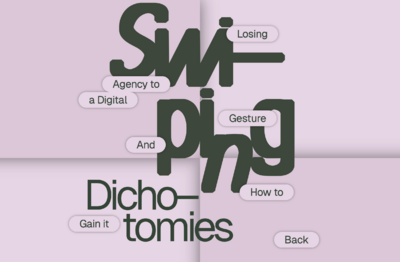
Swiping Dichotomies website by Akseli Manner
In "Swiping Dichotomies," Akseli Manner critically examines the swiping gesture in digital interactions, particularly in dating apps. It explores the origins of swiping, its tactile and psychological effects, and its role in shaping user autonomy. The thesis questions how algorithmic design influences decision-making, reducing complex human interactions to binary choices. By analyzing swiping's cultural and technological significance, Manner highlights the tension between agency and automation in digital interfaces. The work ultimately seeks to reclaim more intentional, nuanced interactions in a world increasingly driven by frictionless, habitual gestures dictated by platform logic and commercial interests.
By examining the origins, cultural significance and tactile nature of swiping, this thesis establishes swiping as both a technological object and a cultural phenomenon. In exploring whether such gestures enhance or diminish autonomy in digital spaces, its analysis aligns with the ideas set out in Coded Gestures[076], as both texts critically examine how embodied technologies can either empower users or subtly dictate behaviour, urging a more intentional approach to gesture-driven design.
26.10.26
[095]
of techne and logos
Individual
critical
'Of Techne and Logos' is a thesis project by Anna Trevisan that explores the cyborg as a condition of digital life and a lens through which to examine gendered power. Across a series of essays, Trevisian considers how digital identity emerges in relation to bodies, images and platforms. The Cyborg Condition, examines the promises of control, belonging and escape offered by online self-presentation, as well as the ongoing work of curation, consumption and self-surveillance that these promises require. 'Programmed to Perfection' expands upon this investigation by examining Ex Machina and Her, tracing the persistence of female cyborg ideals across visible bodies and disembodied voices, reinforced by costumes, interfaces, and atmospheres. A tactile prologue and epilogue contextualise the research as situated practice, and the independently published website extends the inquiry into digital form. The study also acknowledges its limitations, particularly its underdeveloped attention to race, class and genderqueerness.
A productive tension emerges between the essay’s description of unequal systems of aesthetic control and its sweeping assertion that 'we are all cyborgs'. This highlights the profound impact of technology on contemporary life, prompting the question of whether everyone experiences this condition with the same agency or exposure to harm. This question is also relevant to Oftechne.ink, which combines two elements: an exploration of the cyborg as a metaphor and an experimental publishing space driven by code. Built and maintained independently, the site incorporates its mode of circulation into its argument: it is digital, open-source and self-directed.
this body of work has been developed under the support and supervision of, Hanka van der Voet, Alex Esculapio, Lenn Cox, web design and developed by, Anna Trevisan, and Wouter Driessen
26.10.26
[SUBMIT]
As the online realm often feels infinite, this directory highlights non-commercial, critical, and experimental online content related (but not limited) to fashion and creative practices. It features projects, essays, visuals, and events, offering tools to navigate this dynamic landscape.
In gathering a wide variety of practitioners and collectives, we are always expanding, and looking to add to this growing bibliography of ‘being online’.
If you've encountered or created something that fits within this scope, feel free to share and submit!
Retrieved from "https://softwear.directory/index.php?title=Thesis&oldid=4200"