[001]
Fashionable Technology
Individual
autonomous
This book provides an accessible yet thorough overview of electronic textiles and wearable technology, exploring the intersection of fashion, design, and science. Exploring both theory and practice, it demonstrates how technology is integrated into fabrics and garments with detailed explanations and rich visual examples. With contributions ranging from the MIT Media Lab to designer Hussein Chalayan, Seymour showcases a variety of pioneering designers, artists, companies, and research institutes, and highlights their groundbreaking projects alongside surveys of their wider work.
26.09.25
[002]
Cyberfeminism Index
Individual
critical
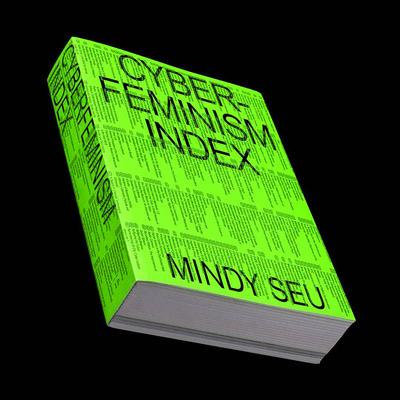
Cyberfeminism Index by Mindy Seu
In Cyberfeminism Index, hackers, scholars, artists, and activists of all regions, races and sexual orientations consider how humans might reconstruct themselves by way of technology. When learning about internet history, we are taught to focus on engineering, the military-industrial complex, and the grandfathers who created the architecture and protocol, but the internet is not only a network of cables, servers, and computers. It is an environment that shapes and is shaped by its inhabitants and their use.
The creation and use of the Cyberfeminism Index is a social and political act. It takes the name cyberfeminism as an umbrella, complicates it, and pushes it into plain sight. Edited by designer, professor, and researcher Mindy Seu, it includes more than 700 short entries of radical techno-critical activism in a variety of media, including excerpts from academic articles and scholarly texts; descriptions of hackerspaces, digital rights activist groups, and bio-hacktivism; and depictions of feminist net art and new media art.
Both a vital introduction for laypeople and a robust resource guide for educators, Cyberfeminism Index—an anti-canon, of sorts—celebrates the multiplicity of practices that fall under this imperfect categorization and makes visible cyberfeminism’s long-ignored origins and its expansive legacy.
“the Cyberfeminism Index is incomplete and always in progress..”
22.03.24
[003]
The Cell for Digital Discomfort (CfDD)
Collective
critical
Formed as part of the 2021/2022 BAK Fellowship for Situated Practice, the Cell for Digital Discomfort (CfDD)—composed of Cristina Cochior, Karl Moubarak, and Jara Rocha—are the guest editors of this special Prospections focus “Digital Discomfort,” a compilation of newly commissioned and archival resources such as texts, interviews, and videos that allow for a collective exploration of sensibilities around an affirmative repoliticization and redefinition of compu-relational practice.
23.04.24
[004]
Multidimensional citation
Collective
speculative
At the start of 2020 we announced our collaboration by sending around a postcard. Three women in stone-colored clothing sat on the ground, our faces staring directly into the camera in a diagonal cascade. The postcard also contained a link to our website where we described ourselves and our collaboration.
Our differences allowed us to come together in a complementary way. An alliance of islands intuitively felt like our symbol: and for this reason we used three dots cascading ⋱ for our website’s favicon — the small icon that appears near the web browser’s address bar.
“A citation should not be singular, but instead explicitly connected to the lineage of research that came before it.”
01.05.24
[005]
An Evening With: Donna Haraway, Bruno Clarke and Rosi Braidotti
07.12.23
19.08.24
[006]
Extending Horizons: The Praxis of Experimental Publishing in the Age of Digital Networks
Individual
critical
This dissertation is focused on the practices of experimental publishing that are intertwined with digital and networked technology, and borrow strategies derived from the context of arts and design. In order to build a model of interpretation of such practices, Lorusso defined a theoretical framework, made an overview of influential perspectives within the field, and carried out an investigation of the ‘communities of practice’ in which experimental publishing takes place. Lorusso analyzes a phenomenology of projects that highlight the characteristics of an experimental approach in each specific stage of the publishing process. Finally, I developed an online archive for the purpose of categorizing and connecting the different case studies. The main question addressed is:
05.06.24
[007]
Zeros and Ones: Digital Women and the New Technoculture
Individual
critical
Zeros and Ones is an investigation of the intersection between women, feminism, machines and in particular, information technology. Arguing that the computer is rewriting the old conceptions of man and his world, it suggests that the telecoms revolution is also a sexual revolution which undermines the fundamental assumptions crucial to patriarchal culture. Historical, contemporary and future developments in telecommunications and in IT are interwoven with the past, present and future of feminism, women and sexual difference, and a wealth of connections, parallels and affinities between machines and women are uncovered as a result. Challenging the belief that man was ever in control of either his own agency, the planet, or his machines, this book argues it is seriously undermined by the new scientific paradigms emergent from theories of chaos, complexity and connectionism, all of which suggest that the old distinctions between man, woman, nature and technology need to be radically reassessed.
01.05.24
[008]
Varia will open its doors for the Counter Cloud Gathering
20.12.23
19.03.24
[009]
Glitch Poetics
Individual
critical
Glitches are errors where the digital bursts or creeps into our everyday lives as fragmented image, garbled text and aberrant event. Today, when computational technology is integrated ever more closely into bodies and social structures, glitches are considered by artists and companies alike as critical and commercial opportunities, revealing tears in the real-virtual binary. Glitch has also increasingly become a metaphor for understanding the political and ecological shocks the world pushes into the mediasphere each day. In Glitch Poetics Nathan Jones shows how contemporary writers and artists are integrating the glitch as a literary effect, an affective critique and a realist reflection, at a time characterised by breakage, corruption and crisis.
Based on a range of close readings of contemporary literature by writers including Linda Stupart, Sam Riviere, Keston Sutherland, Ben Lerner, Caroline Bergvall, Erica Scourti, David Peace and the internet novelists, and drawing on theories of error, shock, glitch, critical posthumanism and code, Jones lays the groundwork for writing that can productively engage in the new situation for literature in the context of AI, the Anthropocene and the post-digital age. His book articulates the working of error in literary and media practice at the horizon of human and machine language.
“Glitch Poetics resists technofuturism, reinventing errancy as a necessary aesthetic value of (and crucially against) our time.”
15.07.24
[010]
Vertical Atlas
Collaboration
social
How to navigate the rapidly changing digital geopolitics of the world today? How do we make sense of digital transformation and its many social, political, cultural, and environmental implications at different locations around the world?
Vertical Atlas brings together the insights of a diverse group of internationally renowned artists, scientists and technologists from different backgrounds and places. From an investigation into the lithium mines in the Democratic Republic of Congo to maps of the fiber-optic submarine cables in the Atlantic and the ride-hailing platforms of China.
Vertical Atlas is not a classic atlas that depicts the world in a uniform manner and it is not a simple collection of traditional maps. This book is a tool that enables comparisons, connections and contradictions between different and diverse visions, realities and worlds – through newly commissioned diagrams, interviews, essays and works of art by leading experts from around the world.
30.04.24
[011]
Our aesthetic categories: Zany, Cute, Interesting
Individual
philosophy
The zany, the cute, and the interesting saturate postmodern culture. They dominate the look of its art and commodities as well as our discourse about the ambivalent feelings these objects often inspire. In this radiant study, Sianne Ngai offers a theory of the aesthetic categories that most people use to process the hypercommodified, mass-mediated, performance-driven world of late capitalism, treating them with the same seriousness philosophers have reserved for analysis of the beautiful and the sublime.
Ngai explores how each of these aesthetic categories expresses conflicting feelings that connect to the ways in which postmodern subjects work, exchange, and consume. As a style of performing that takes the form of affective labor, the zany is bound up with production and engages our playfulness and our sense of desperation. The interesting is tied to the circulation of discourse and inspires interest but also boredom. The cute's involvement with consumption brings out feelings of tenderness and aggression simultaneously. At the deepest level, Ngai argues, these equivocal categories are about our complex relationship to performing, information, and commodities.
Through readings of Adorno, Schlegel, and Nietzsche alongside cultural artifacts ranging from Bob Perelman's poetry to Ed Ruscha's photography books to the situation comedy of Lucille Ball, Ngai shows how these everyday aesthetic categories also provide traction to classic problems in aesthetic theory. The zany, cute, and interesting are not postmodernity's only meaningful aesthetic categories, Ngai argues, but the ones best suited for grasping the radical transformation of aesthetic experience and discourse under its conditions.
24.04.24
[012]
Mission Accomplished: Belanciege
Collaboration
politics

Trafó Gallery, photo by Dávid Biró
Hito Steyerl "Mission Accomplished: BELANCIEGE" is part of the exhibition "… of bread, wine, cars, security and peace". The point of departure for the three-channel video installation is the fall of the Berlin Wall in 1989 and how this historical event paved the way for commodification and privatization. The artists turn to the field of fashion, using the luxury brand Balenciaga as an example to reflect on political and cultural changes in the period of the last thirty years. The video installation MISSION ACCOMPLISHED: BELANCIEGE presented at Trafó Gallery reveals similar ’invasions’ of history and emphasizes their cyclical nature by turning towards the processes of economic and political realignment that followed the fall of the Berlin Wall, and by featuring examples that target our hyper-contemporary world armed with trend analysis, data mining, political advertising and audience targeting.
The video installation is co-created by Giorgi Gago Gagoshidze, Hito Steyerl and Miloš Trakilović and is based on their lecture in 2019 at n.b.k. - Neuer Berliner Kunstverein. Almost 30 years to the day after the fall of the Berlin Wall, the lecture reflects on post-1989 transformations and political rearrangements in the former Soviet territories, sheds light on the interconnections between culture and populism, and examines in a broader context the mechanisms of oligarchic-capitalist culture that emerged during the 'privatisation' of the former Eastern bloc.
01.05.24
[013]
A Traversal Network of Feminist Servers
Collective
social
A Traversal Network of Feminist Servers is a collaborative project formed around intersectional, feminist, ecological servers whose communities travel between each other to share and extend their skills through live gatherings. Such platforms and tools are necessary to navigate our communications and cultural growth beyond the current media oligopolies and democratize cultural and political expression outside obscure algorithms and advertising monetization. The project is documented through a mobile server and a print publication, each chapter being shaped by a partner.
01.05.24
[014]
The User Condition: Computer Agency and Behaviour
Individual
critical
The User Condition is a micro-interactive essay on computer agency and behavior, and was developed within the 2020 research group organized by the Lectorate Design of KABK. What are the conditions for a computer user to gain agency, defined here as the ability to evade automatisms? What is the user’s horizon of autonomy within a built world made of software programmed by somebody else, when its logic is made inaccessible in the name of convenience?
01.05.24
[015]
Interdependence FM
Collaboration
speculative
In an age where global events, technologies, and cultures are increasingly intertwined, the Interdependence FM podcast explores the intricate web of connections shaping our world. While the hosts talk to artists and experts in the field of AI (and beyond) and are mainly positive about the 21st century, it becomes clear that understanding the concept of interdependence has never been more crucial.
01.05.24
[016]
ArtBase Anthologies in conversation with Auriea Harvey
03.04.24
30.04.24
[017]
Digital Research Methods in Fashion and Textile Studies
Individual
pedagogy
Digital Research Methods in Fashion and Textile Studies presents the reader with a variety of digital methodologies to help build skills in searching for, analyzing, and discussing vintage design, photography, and writing on fashion, as well as historic and ethnographic dress and textile objects themselves. Each chapter focuses upon a different method, problem, or research site, including:
- Maximalism and mixed-methods approaches to research
- Searching large databases effectively
- Pattern recognition and visual searching.
- Critical reading, use, and citation of social media texts
- Digital ethnography and shopping as research
- Data visualization and mapping
- Images in the public domain
From advanced undergraduates and postgraduate students working on research projects to veteran professionals in fashion and textile history and beyond, everyone can benefit from a diverse set of fresh approaches to conducting and disseminating research. In the current age of instant gratification, with users snapping and posting images from runway shows long before the clothes will ever appear instores, the world of fashion is increasingly digital and fast-paced. Research on fashion is, too. Digital Research Methods in Fashion and Textile Studies will help you keep up in this rapidly changing world.
22.04.24
[018]
Figuring Things out Together
Individual
critical
This dissertation explores matters of collectivity, drawing from the experience of working with the Amsterdam-based collective Hackers & Designers (H&D). The main thesis of this research is that conventional design vocabularies are not capable of sufficiently expressing and accounting for collectivities‘ resistance to fixation and stabilization. Collective design as it is discussed here challenges notions of individual authorship, differentiations between disciplines, between product and process or between the user and maker. While collectives shape particular affiliations and commitments, design approaches and aesthetics, they also require perspectives on working and designing together that resist linearity, and a progress-based understanding of a design process. By means of several case studies, it is argued that the fragmentation of social and work relations is as much a characteristic of collective practice as the effort to sustain long-term relationships.Thus, collective practice is not fully deliberate, at least not in the same way as for instance ‘teamwork’, ‘the commons’, or ‘cooperativism’, are purposeful organizational frameworks for living, working or being together. Collective Collective design processes take part in and are a result of particular (often fragile) socio-economic, socio-technical conditions that pervade and shape the ways collectives function.
“This publication derives from an enthusiasm for the various ways collective learning environments take shape. It grew out of a curiosity for the ways that such practices are shared across different localities, timelines, and experiences.”
05.06.24
[019]
Syntax Magazine
Collaboration
experimental
Syntax is an online magazine using the grammar of the internet. The editors letter of Syntax's first edition reads:
"Digital media promised us new modes of reading. Instead, we got sound bites and “which One Direction member should you date” quizzes. Scrolling online became an experiment in self-defense: we’re bombarded by paywalls and pop-up ads, lured by A/B tested headlines and microtrend pieces. [...]
But no one writes how we read. In chat rooms, comment sections, forums, personal blogs. The video essay, the playlist, Tumblr collage—these forms are as familiar to us as the novel, film, and album. Their words would never reach the true citizens of the internet.."
And so, Syntax provides a honest reflection of what pre-capitalist internet.
“So we go back to the blog. Repurpose the zine. We’re sending our reply using the grammar of the internet.”
01.05.24
[020]
Softer Digital Futures: London Edition
16.03.24
30.04.24
[021]
Networked Worlds
Collaboration
experimental
‘Networked Worlds’ focuses on worlding as a creative strategy in the early 21st century. As a response to the multiple crises of our time – a crisis of reality, agency and traditional sensemaking structures – worlding is an emergent creative practice of re-imagining and prototyping alternative futures.
Hyper aware of the rules and power structures of dominant narratives and infrastructures, worlding has become a vital strategy for artists and creatives to experiment with alternative futures and render the conditions of the present visible in order to change them. Worlding as such is different from worldbuilding. While the latter has been established by writers, directors, set designers in creating believable imaginary worlds (think Star Wars, Lord of the Rings or the Marvel Universe), worlding signifies the continuous, ever-evolving, collaborative effort of making worlds emerge rather than creating a closed universe by an individual master creator.
Networked Worlds is the third part of Networked Culture, a series of publications that explore the effects of networked technologies on the creative process. The previous two memos of the series are Networked Counterculture (2023) and Networked Reality (2023).
“Worldbuilding is a means to resist complacency and categorization; an affirmation that one can draw new borders (or ends) and declare new logics for life.”
02.04.24
[022]
Pirate Care, a syllabus
Collective
critical
Pirate Care is a research process - primarily based in the transnational European space - that maps the increasingly present forms of activism at the intersection of “care” and “piracy”, which in new and interesting ways are trying to intervene in one of the most important challenges of our time, that is, the ‘crisis of care’ in all its multiple and interconnected dimensions.
These practices are experimenting with self-organisation, alternative approaches to social reproduction and the commoning of tools, technologies and knowledges. Often they act disobediently in expressed non-compliance with laws, regulations and executive orders that ciriminalise the duty of care by imposing exclusions along the lines of class, gender, race or territory. They are not shying risk of persecution in providing unconditional solidarity to those who are the most exploited, discriminated against and condemned to the status of disposable populations.
The Pirate Care Syllabus presents here for the first time is a tool for supporting and activating collective processes of learning from these practices.
“We live in a world where captains get arrested for saving people’s lives on the sea; where a person downloading scientific articles faces 35 years in jail; where people risk charges for bringing contraceptives to those who otherwise couldn’t get them. Folks are getting in trouble for giving food to the poor, medicine to the sick, water to the thirsty, shelter to the homeless. And yet our heroines care and disobey. They are pirates.”
01.05.24
[023]
SUPERSTORM. Design and Politics in the Age of Information
Individual
politics
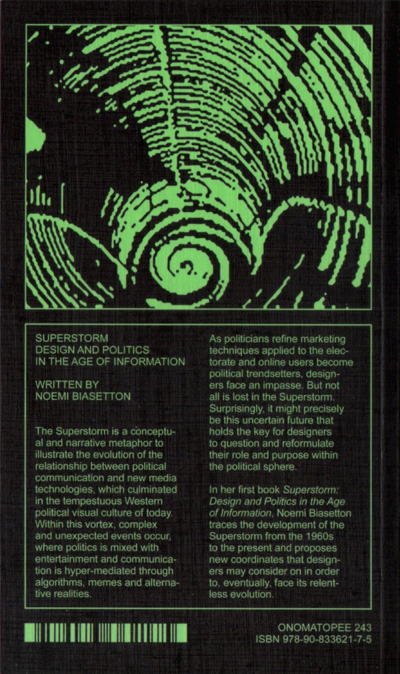
SUPERSTORM. Design and Politics in the Age of Information, 2024 - Cover (Credits: Noemi Biasetton)
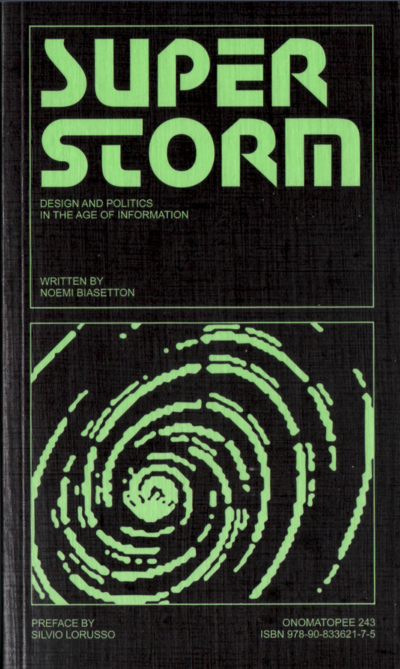
SUPERSTORM. Design and Politics in the Age of Information, 2024 Backcover (Credits: Noemi Biasetton)
The Superstorm is a conceptual and narrative metaphor to illustrate the evolution of the relationship between political communication and new media technologies, which culminated in the tempestuous Western political visual culture of today. Within this vortex, complex and unexpected events occur, where politics is mixed with entertainment and communication is hyper-mediated through algorithms, memes and alternative realities.
As politicians refine marketing techniques applied to the electorate and online users become political trendsetters, designers face an impasse. But not all is lost in the Superstorm. Surprisingly, it might precisely be this uncertain future that holds the key for designers to question and reformulate their role and purpose within the political sphere.
In her first book Superstorm: Design and Politics in the Age of Information, Noemi Biasetton traces the development of the Superstorm from the 1960s to the present and proposes new coordinates that designers may consider on in order to, eventually, face its relentless evolution.
22.04.24
[024]
Our Bodies, Online
Individual
social
What are the qualifications of being a feminist artist today? This is an impossible question, which is, in many ways, the point. One of the defining doctrines of third-wave feminism (or fourth-wave feminism, or postfeminism, or whatever you call our current moment) is its persistent unwillingness to be defined. Whether you make abstract photograms or stag films, label your work feminist, and it is.
“An emerging guard of young, female photographers has carved out a new brand of feminism
with a new set of definitions.”
01.05.24
[025]
HTTPoetics Showcase
13.04.24
30.04.24
[026]
“Trust Us, We’re You”: Aspirational Realness in the Digital Communication of Contemporary Fashion and Beauty Brands
Individual
critical
In recent years, a number of fashion and beauty brands have developed promotional content that circulates an aspirational quality imbued with unstudied “cool” around their product. Despite the appeal of this conceit to tropes of the everyday, authenticity, and belonging, it presents a superficially relatable ideal whilst exploiting digital media’s capacities to foster intimacy and promote a postfeminist subjectivity based on consumption.
This article examines three brands that circulate “aspirational realness” around their product: Glossier, Reformation, and Maryam Nassir Zadeh. All remediate the conventions of prior fashion media to communicate discourses of neoliberal femininity to a media-savvy consumer. Aspirational realness is thus read as a means by which consumption is both encouraged and situated as a means of self-realization in the likeness of other aspirational “cool girls.”
01.05.24
[027]
Fashion Paratext Dataset
Collaboration
critical
The FASHION PARATEXT DATASET focuses on the collection and analysis of fashion captions within contemporary fashion media. Although often overseen and rendered subordinate, these paratextual snippets of text-such as titles, introductions and captions-work as strategic value producers within fashion media and shape our fashion narratives and vocabulary. Accordingly, these textual elements play an important role in our relation to fashion and clothes as readers, wearers, makers and consumers. Through its dominance and vast networks, industrial market-based fashion language is becoming our fashion mother tongue. And as professor of applied linguistics Robert B. Kaplan writes, our first language, or mother tongue has a powerful influence on the way we shape our thoughts and organise our ideas.
Using data science methods, this project collaboratively produces a large-scale dataset of fashion captions that can be mapped and analysed using Natural Language Processing. The dataset takes the captions out of the saturated pages of fashion media (both print and online), offering the opportunity to read them attentively, isolated from their original context. As such, it can open up space to think about an alternative vocabulary.
“This website explores the unique poetic character of fashion captions, and text in general of its media systems.”
23.04.24
[028]
A Guide To Softer Ware
Collaboration
experimental
A Guide To Softer Ware is a collaborative exploration of contemporary and not-so-contemporary languages of instruction in the context of “womanhood”, calling out their binary notions of gender designation as a social construct. Through analysing their own behavior as socialised women, and simultaneously analysing guides by women addressing other women about how to be a woman, Charlotte Rohde and Vera van de Seyp expose the idea of the manual as a (self-)imposed directive, trapped between the imperative to be unconditionally affirmed and the need to be in charge of one’s own narrative.
The format of the manual is used here as a rhetorical construct that explores how the social roles of women have been impacted by the rise of new technologies from the second half of the 20th century until now. With their shared background ranging from (type-)design to creative coding, Charlotte Rohde and Vera van de Seyp (quite literally) deconstruct and reprogramme these languages of instruction: From the wording used in 1960s technical manuals for sewing machines, knitting machines and various domestic appliances addressing women as a new target group to Memes and YouTube tutorials as a phenomenon representing the contemporary internet culture of self-optimization.
With their Guide To Softer Ware the two artists reflect on the supposed need for guidance and the forms this guidance has historically taken and still takes. The exhibition at soft power presents new works by the two artists that may function as a manual for the spectators and simultaneously as type specimens. The use of tools and typography, soap and metal, software and code (and ultimately, the use of the body itself), invites us to question the „softness“ historically/conventionally/subconsciously assigned to certain materials and spaces, to gender and its construction.
23.04.24
[029]
Girl Online: A User Manual
Individual
social
What happens when a woman goes online? She becomes a girl.
The unwritten contract of the internet, that a user is what is used, extends from the well-examined issue of data privacy and consent to the very selves women are encouraged to create in order to appear. Invited to self-construct as 'girls online', vloggers, bloggers and influencers sign a devil's bargain: a platform on the condition they commodify themselves, eternally youthful, cute and responsibility-free, hiding offline domestic, professional and emotional labour while paying for their online presence with ‘accounts’ of personal ‘experience’. Can a Girl Online use these platforms not only to escape meatspace oppressions, but as spaces for survival, creativity and resistance?
Told via the arresting personal narrative of one woman negotiating the (cyber)space between her identities as girl, mother, writer, and commodified online persona, Girl Online is written in a plethora of the online styles, from programming language to the blog/diary, from tweets to lyric prose, taking in selfies, social media, celebrity and Cyberfeminism.
23.04.24
[030]
Our Digital Selves
Collaboration
speculative

‘Ecstatic Wholeness’ by The Fabricant

‘Ecstatic Wholeness’ by The Fabricant
"With the emergence of the Metaverse, we can reinvent ourselves in ways in which we’ve always dreamt. Modem teamed up with The Fabricant, SHOWstudio and Anastasiia Fedorova to imagine how our virtual alter-egos could change the ways we think about ourselves. Expanding on the work of The Fabricant, which explores the malleable future of human identity through non-physical garments, Our Digital Selves studies the ambiguous relationship between the real and the virtual self"
“When musing on fashion and identity, it’s always worth asking: when does wearing something truly change the meaning of who we are?”
01.05.24
[031]
A Website is a Room
Individual
autonomous
A-website-is-a-room.net is a little handmade web space that features a live feed of urls of a similar sentiment, anonymously contributed by fellow internet travelers. This site is the distillation of extensive research, conversations, and experiments around alternative web practices, decentralized networks, and online gathering.
The goal was to make something communal, romantic, introspective, raw, and beautiful. I also really wanted to dive deep into the research, and in that process, discovered a whole world of like-minded people, learned about new and old tools, and drew unexpected connections between different artists, designers, and their works.
23.04.24
[032]
Glitch Feminism: A Manifesto
Individual
critical
A new manifesto in cyberfeminism: finding liberation in the glitch between body, gender and technology.
The divide between the digital and the real world no longer exists: we are connected all the time. How do we find out who we are within this digital era? Where do we create the space to explore our identity? How can we come together and create solidarity?
The glitch is often dismissed as an error, a faulty overlaying, but, as Legacy Russell shows, liberation can be found within the fissures between gender, technology and the body that it creates. The glitch offers the opportunity for us to perform and transform ourselves in an infinite variety of identities. In Glitch Feminism, Russell makes a series of radical demands through memoir, art and critical theory, and the work of contemporary artists who have travelled through the glitch in their work. Glitch Feminism shows how the error can be a revolution.
“Within glitch feminism, glitch is celebrated as a vehicle of refusal, a strategy of nonperformance.”
20.11.24
[033]
A Collective Booklet for Computational Woman
Individual
social
A Collective Booklet for Computational Women is an open document project on google sheets to share stories of women with their machines. Any woman can create their own sheet to share their photos and the stories they hold about their computers. It is created to protest against the stereotype and to empower our passion towards technology.
“Growing up, I was always curious about computers and technology, and I've often heard people say things like 'it's weird that you're good with computers as a girl'.”
30.04.24
[034]
Seduced & Abandoned: The Body in the Virtual World - The Feminine Cyberspace
Individual
critical
Sadie Plant argues that cyberspace is a potentially radical space which uses modes of thinking and operating that have traditionally been seen as female. She also considers the relationship between cyberspace and immaterial space and speculates on what this could mean for the future. Christine Tamblyn and Pat Cadigan contribute to the discussion/Q&A, which makes for a lively discourse on the females positioning in technoculture.
30.04.24
[035]
Fashion Knowledge Podcast
Individual
pedagogy
Fashion Knowledge is a podcast about inclusive, sustainable, and digital fashion futures. Beata Wilczek, founder and director at Unfolding Strategies, a fashion consultancy and edu lab for fashion in Web3, hosts new and brave voices in fashion innovation, design, research, and education, to learn more about digital fashion and sustainability.
23.04.24
[036]
GIRLSTACK
Individual
speculative

image by siir bicer
Building on the ideas of Tiqqun’s 1999 anti-neoliberal treatise Preliminary Materials for a Theory of the Young-Girl, Andrea Long Chu’s Females and Bogna Konior’s work on the girl and the inhuman vis-a-vis the machinic, Quicho has developed a concept she calls the “Girlstack,” which, to borrow her words, models the “ultrasmooth, cybergothic, and angelic dimensions of the girl’s natural habitat.” Quicho articulates how the ‘girl’ inhabits no one person, body, or gender. She is a technology of subjectivity composed of symbolic, consumer, and inhuman elements and might be our only way out of the platform trap. Quicho's reformulation of 'the stack' was first published as an essay on Wired and expanded at BODYSTACK and Creamcake 3HD.
Quicho’s girl-stack is a speculative prototype models themany dimensions of the girl’s natural online habitat. To be clear: Quicho does not speak of actual girls or the experience of lived girlhood, but a socially constructed ideation of the girl. So, the girl as a vehicle for selling product, the girl as a tool for manipulating entrenched power, the girl as living currency, and the girl as desiring machine. The model is imperative for understanding the environment that produces the ‘girl as condition’.
30.04.24
[037]
Notes on Phygitality
Collaboration
speculative
Published in Issue#6 of NXS Magazine ‘Phygital Fashioning’, ‘Notes on Phygitality’ documents an asynchronous dialogue held in the spring of 2022.
The conversation delves into the concept of "phygitality," blending physical and digital realms. They explore its implications, noting, "It’s about how you can interface between the physical and the digital." Discussions encompass the fusion's impact on human interaction voicing that we have more freedom to express ourselves. Ethical dimensions are scrutinized: "We need to be careful about what that [digital footprint] means." The dialogue reflects on art, privacy concerns, and the intricate interplay shaping future socio-technological landscapes.
01.05.24
[038]
Cyberwitches and Feminist Technologies seminars
17.09.24
03.07.24
[039]
The SSENSE of Authenticity
Individual
critical
In "the ssense of authenticity" writer Nabi Williams explores the concept of authenticity in the digital age, particularly through analyzing the canadian fashion e-tailer ssense and its popular Instagram account. posting daily on the social media platform, ssense draws from contemporary culture through its use of language, image layout, and cultural references to create promotional content that exists on the thin line between “authentic meme” and marketing material. by investigating this account and social media’s impact on how authenticity is manufactured, communicated, and perceived, this thesis traces how the concept of authenticity has evolved and argues that we now live in a “post-authentic” world, where storytelling and the “authentically inauthentic” reign supreme in place of sincerity and reality.
“The reality is that “authenticity” holds no value. But then again, who wants to engage in reality?”
04.09.24
[040]
Scroll, Skim, Stare
Individual
critical
This essay critiques the static nature of artists' websites, proposing that they could be more dynamic and innovative. Gat argues for these sites to function as online exhibition spaces, offering unique and creative ways to present and control art, enhancing the digital art experience.
Orit Gat’s essay “Scroll, Skim, Stare” in *The White Review* explores the evolving role of artists' websites in the contemporary digital landscape. Gat argues that while the internet has transformed art consumption, the design of artists' websites often remains static and uninspired. She suggests that these sites could be more dynamic, serving as online exhibition spaces that challenge the traditional gallery format. Gat emphasizes the potential for artists to leverage their websites to present and control their work uniquely and creatively, thus reshaping the visual culture of the internet.
19.08.25
[041]
I'm Like a PDF but a Girl
Individual
pedagogy
A literary and ethnographic analysis of the Tumblr platform, supplemented by personal experiences, to explore the site's potency as a pedagogical tool. Ester Freider explains.. "I'm Like a Pdf but a Girl originates from my usage of tumblr as a social learning platform during high school, when AFK I had little educational resources surrounding feminist studies, philosophy, and potential leftisms in my high school and so, turned to a network of peers online to educate myself."
“Embrace subjectivity. Nomadologize. Unclog digital neuroses. Reconnect with the ancients. Atomize. Overflow with information. Make love piratic. Plagiarize with the girls. Weave webs of excess. Become a girlblogger.”
03.07.24
[042]
From a Tool to a Culture : Authorship and Professionalism of Fashion 4.0 Designers in Contemporary Digital Environments
Individual
This thesis looks at how fashion design is affected by new technology. It contributes to fashion studies and design research. It uses ideas from authorship theory, sociology of professions and posthumanism. The research looks at four fashion design practices where creation takes place in virtual spaces and is shared with non-professionals, networks or machines. The case studies are The Fabricant, Atacac, Self-Assembly and Minuju.
04.07.24
[043]
A Reparative Approach to Publishing
Collaboration
The article "A Reparative Approach to Publishing" discusses Constant, a collective focusing on open-source, community-driven publications. Their projects include various forms of "executable texts" like manuals and codes, emphasizing collaborative creation and iterative processes. Platforms like Books With An Attitude and Constant Verlag host these works under open licenses. The piece highlights the importance of trust, collective authorship, and dynamic, editable content, advocating for a publishing practice that embraces change, diversity, and community involvement over individual genius and static texts.
It is part of MARCH's long term inquiry, "Publishing As Protocol", which aims to explore the relationship between self-organizational models and technological sovereignty. It gathers existing and speculative examples from both institutional (cultural) and technological (hacktivist) practices to reflect on how we publish, gather and organize under (and around) platform capitalism.
“A reparative, intersectional, and feminist approach to publishing means a networked approach, set up for working best when it is cared for by one or many communities.”
08.07.24
[044]
Transactional Aesthetics
Individual
pedagogy
da Falck Øien explores the emotional relationships humans have with their garments and how acquisition methods influence these relationships. The research, conducted from 2017 to 2021, involves ethnographic studies, collaboration with a fashion label, public engagement through a physical space, and the creation of publications and products. Øien aims to address the environmental impact of the fashion industry by rethinking resource use and consumer behavior, emphasizing fashion as a cultural and social phenomenon beyond mere clothing items.
04.09.24
[045]
OPEN CALL – Screening: Luxury
18.08.24
09.07.24
[046]
Angels, Bots, Cute AIs and Animism: A Conversation on AI Imaginaries
10.07.24
08.07.24
[047]
Sublime Heartbreak: Vectors for an Ending of Times
Individual
Speculative

Image by Elizabeth Gabrielle Lee

Endarkenment pantheon and its vectors: Possibility ⟷ Futility, Introspection ⟷ Reactivity. The intersection of these vectors (aka quadrants) give rise to aesthetic guilds. Image by Elizabeth Gabrielle Lee
This essay explores the concept of "Endarkenment," an aesthetic response to current global crises. Instead of apocalyptic destruction, Endarkenment finds beauty in chaos and decay. It contrasts traditional enlightenment, emphasizing engagement with darkness and complexity. Four aesthetic "guilds"—NovusHex, Netmesh, Candyblade360, and Hyper-ogre—illustrate different aspects of this concept, embracing both technological and primitive elements to find new forms of meaning and enchantment amid widespread despair and systemic failures.
The essay's concept of "Endarkenment" connects to how we experience fashion online by highlighting emerging digital aesthetics and trends that embrace chaos, complexity, and non-traditional beauty. Online fashion communities reflect this through styles like "indiesleaze" and "ratgirlsummer," which celebrate raw, unpolished looks, and "technomysticism" that merges spirituality with cybernetics. Platforms like Instagram curate these trends, showcasing designs that fuse nature with technology or embrace hyper-femininity and grotesque, anti-minimalist aesthetics. These digital movements redefine fashion by rejecting conventional norms and finding beauty in unconventional, dark, and chaotic expressions.
“I propose Endarkenment, an aesthetic posturing that’s emerging from the abyss of ultimate system failures and chronic mass despair. I’m not interested in a doomsday, pure-nihilistic dystopian narrative.”
16.07.24
[048]
Declarations: Website fabulations
07.09.24
09.07.24
[049]
Performing Cyber Tenderness
Individual
social
This text discusses the concept of the "Sad Girl" and its evolution in the digital age. It explores how the internet, particularly platforms like Tumblr, became a space for young women to express their emotions, often through romanticized depictions of sadness and melancholy. The text examines the authenticity and commodification of these emotional performances, as well as the broader societal expectations and pressures placed on women's emotional expression. It also touches on the concept of the "Influencer" and how the pursuit of authenticity has become a tool for capitalist exploitation. The document ultimately suggests that embracing the "Cyborg" and the performative nature of online identity may be a way to resist the commodification of emotion and reclaim digital spaces.
““As you gaze at the flickering signifiers scrolling down the computer screens, (…) you have already become posthuman.””
15.07.24
[050]
Fred Perry x Raf Simons interactive lookbook
Company
commercial

Fred Perry x Raf Simons AW19 by Random Studios
The Fred Perry x Raf Simons SS19 collaboration is presented within an immersive editorial lookbook, honouring an everyday interface familiar to many. Worn by anonymised individuals, the garments can be viewed in a navigable environment, where modified stills create the setting of a universal suburb. Each garment can be examined up-close, with options to view it in situ or in the shop. Location URLs of found garments, sound snippets or visual frames can be shared on social media. The entire campaign can also be viewed as a series of semi-accidental screenshots.
This is the first instalment in a three-part exploration of 360 storytelling. Part two centres around 80s Youth Archive photographs, while part three, 'A Lookbook of Many Gazes', allows the viewer to see the SS20 collection through the eyes of many.
While lookbook offers an examination of the intersection of fashion and digital culture as it immerses the viewer in a hyper-stylised digital environment, utilising motion sensors and abstract imagery to transform familiar, lived experiences into something eerily distant when played out on screen. This dissonance challenges our perceptions of reality, suggesting that the digital mediation of fashion can distance us from the authenticity of human experience, making the familiar strangely unsettling.
06.08.24
... further results


